Showing posts with label Natura. Show all posts

Thursday, November 16, 2023

Word-nerd fun: Galaxy

Photo of the Milky Way
taken by my son John
10 November 2023
Yesterday I was reading Chaucer’s delightful Parliament of Fouls. Early on, the narrator says he fell asleep reading Cicero’s “Dream of Scipio,” and he retells the story for the reader. In the dream, Scipio meets his grandfather who “showed him the Galaxy.”

Then today I was reading The Marriage of Philology and Mercury, a 5th century Latin work by Martianus Capella. In Book II, Philology is ascending through the heavenly spheres on her way to the wedding. When she reaches the upper limits of the cosmos, the narrator says, “The incandescence of a milk-white river gradually flowed down from the burning stars. Full of joy and thanksgiving she turned toward the Galaxy where she knew that Jove had assembled the divine senate.”

I wondered whether the word “galaxy” was used in the original Latin so I looked it up and sure enough it says, “iter in Galaxeum flectit.” Galaxias is itself a borrowing from Greek.

The story behind the word galaxy is a fun one, so I thought I’d share it.

Prior to modern astronomy, Galaxy simply meant the Milky Way, γάλα [gala] being the Greek word for milk. The story is that after Zeus’s son Heracles was born to the mortal woman Alcmene, Zeus waited till his wife, Hera, was asleep and put the newborn to nurse from her so he could partake of the divine quality of her milk and become divine himself. When Hera woke up and found she was nursing a strange infant, she thrust him away causing milk to spurt from her out into the heavens, and that’s the origin of the Milky Way.

If you study the word “galactic,” you’ll see “lac” in the middle of it. This is because the Latin root lac, milk, seems to have come from an earlier word which has been reconstructed as either *g(a)lag- or *g(a)lakt-. In English, we get from this root lactate, latte, and even lettuce.

Our word milk comes from the Indo-European root melg- which is a verb and means “to rub off,” and also “to milk.” It’s related to the word emulsion which comes from the Latin emulgeo, “to milk out.” In English, the verb milk seems to predate the noun milk. It’s been used from the beginning to refer specifically to human or animal milk. Incidentally, mammals and the mammary glands are named after mamma, which means mother in English, but it means breast in Latin. They both come from the same root, ma-, which means mother, and gives us the Greek Maia (good mother) and also maieutic, which means to act as a midwife, and is the word 17th century philosophers used to describe the Socratic method.

The Old English language also used the word milk to refer to the milky juice you can get from a plant. The 2nd century text Herbarium by Pseudo-Apuleius describes getting milk from wyrte/wort, meaning from a plant (think of the “wort” in St. John’s Wort). “Almond milk” has been used since at least the 1300s, so keep this in mind next time one of your friends scoffs at people talking about almond milk, and insists that milk can only properly refer to that which is produced by the mammary glands. :-D


* In linguistics, the asterisk before a word means that the word can’t be found written anywhere, so scholars have made an educated guess about what it probably was.

Tuesday, February 2, 2021

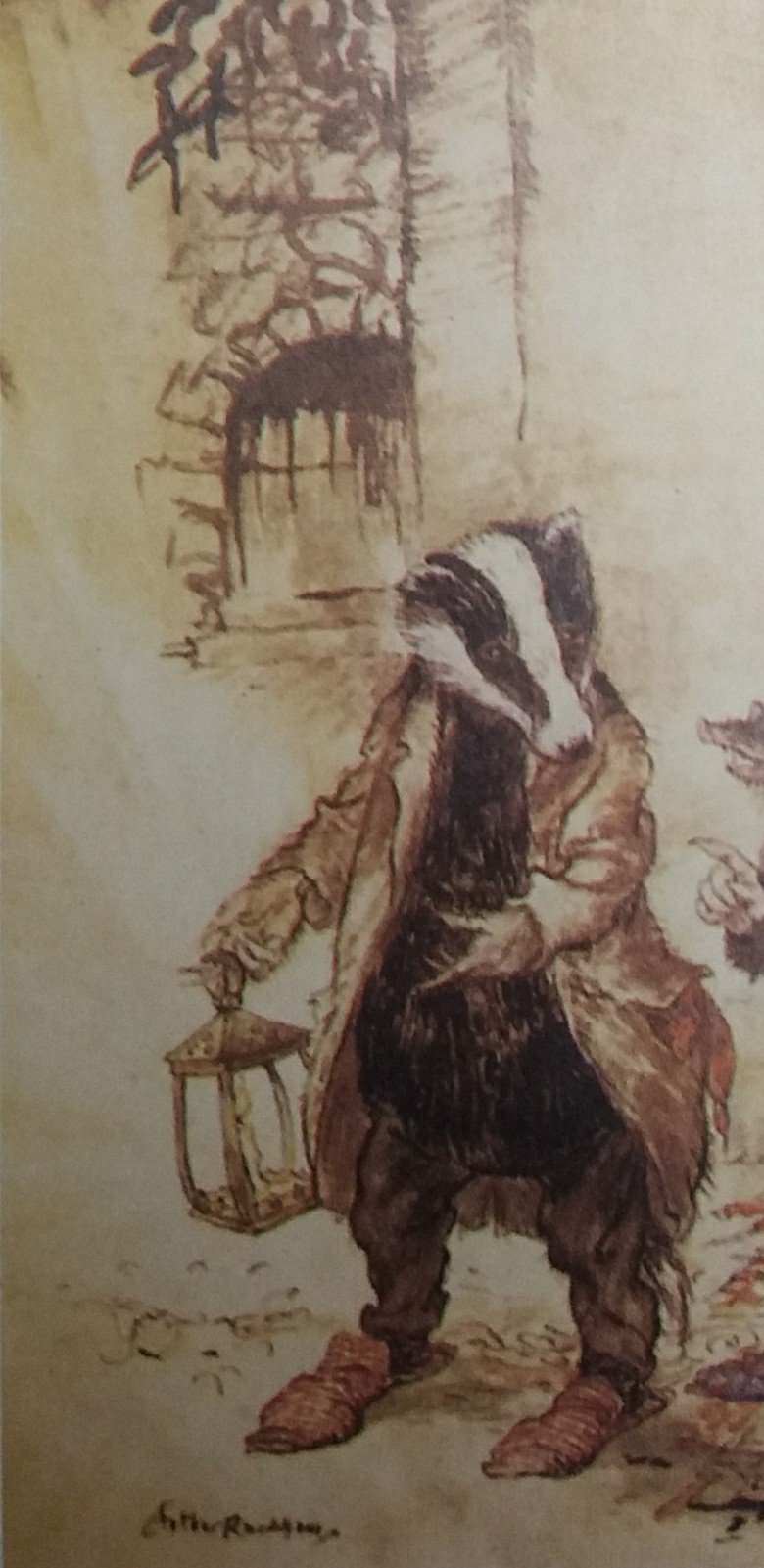
Badgers


 “I’m a beast, I am, and a Badger, what’s more. We don’t change. We hold on.” 

This is Trufflehunter in CS Lewis’s Prince Caspian, explaining to Nikabrik the dwarf why they must protect Caspian and restore him to his rightful throne: “Narnia was never right except when a son of Adam was King.” 

Yesterday morning I was listening to Numbers chapter 4 and noticed how often badgers’ skins were mentioned. Over and over, as the tabernacle and its contents are described, it mentions a covering of badgers’ skins—seven times, in fact. 

It’s not an accident that Trufflehunter and Mr Badger (from The Wind in the Willows) are the way they are. They endure. They protect the holy things.

Tuesday, January 26, 2021

Cedars


 I was reading Leviticus 14 this morning and was struck by the use of cedar wood to be burnt with certain offerings -- specifically those pertaining to being cleansed from leprosy, which is a kind of rot.

Here's what I know about cedar -- it's high in oil, which means that it's resistant to rot. You can cut down a cedar tree, lop off its branches, and use it for a fence post without having to cure it, which is why a LOT of old fence posts around pastures are cedar trunks. They'll last a long time just stuck in the ground like that.

Also, because of that oil content and how aromatic it is, certain bugs hate it, especially the kinds that get into your clothes and ruin them, like moths. This is why cedar chests are popular for storing sweaters, and if you have the resources for it, a cedar-lined closet is ideal.

All this reminds me of the passage that says, "Lay not up for yourselves treasures on earth, where moth and rust doth corrupt . . . "

Cedar being used the way it is, including in the Temple, seems to point us to the Resurrection where there will be no more death. 

Thursday, January 14, 2021

Winter rest


I was going to write a beautiful post about the gloriously busy holiday season and the need for rest before I go back to teaching again in February, but I’m too tired. The days are cold, and dark, and dreary. Nature is saying, “Rest,” so I will rest.

Monday, August 10, 2020

Layers of meaning

I originally wrote the post below in April of 2019, but this past week I reread Macbeth for a class I’m teaching in Medieval cosmology and something new occurred to me this time through.

The story of the woman with the lap full of chestnuts can be looked at it from a different angle. A witch came to her wanting to take her blessings, and the woman, recognizing the evil creature, told the witch to leave, and she left. The witch attacked the husband’s ship, but she couldn’t do any permanent harm:

Though his bark cannot be lost,
Yet it shall be tempest-tossed.

Evil influences can be refused. Macbeth and his lady could have rejected their evil impulses, but they chose not to.

And in Medieval and Renaissance literature, those two meanings (this one, and the one in the post below) can both be true at the same time. In his Anatomy of Criticism, Northrup Frye calls this the “principle of manifold or ‘polysemous’ meaning.”

~*~ ~*~ ~*~


First impressions of Shakespeare's Macbeth, Act I, Scenes 1-5


That’s an awfully boring title, isn’t it? I couldn’t think of anything clever. :-p

The kids and I are reading Macbeth for our Medieval and Renaissance Literature class with Angelina Stanford, and I had some random things I wanted to write down before I forgot them, so here they are.


The Weird Sisters, Henry Fuseli, c. 1783


First Witch:
A sailor’s wife had chestnuts in her lap
And munched and munched and munched. “Give me,” quoth I.
“Aroint thee, witch,” the rump-fed runnion cries.
Her husband’s to Aleppo gone, master o’ th’ Tiger;
But in a sieve I’ll thither sail,
And, like a rat without a tail,
I’ll do, I’ll do, and I’ll do.

This sailor must be must be quite a man, given the trip he’s on, the ship he masters, and the fact that the Witch says she can’t sink his ship. She can, however, curse the husband of this foolish woman.

I’m saying she’s foolish because here she is with her lap full of blessings gobbling them so greedily that she won’t even share when an old woman asks for some.

If you know anything about fairy tales, you know that’s a huge mistake, a mistake of wicked stepmother proportions.

The chestnuts caught my attention though because so often the chestnut tree is used in literature as a symbol of happiness and prosperity. If you know anything about Macbeth, you know that this most definitely isn’t a story about happiness and prosperity.

Let me go back to the beginning.

The Tragedy of Macbeth opens with the stage direction, “Thunder and lightening. Enter three Witches.” These three make a plan to meet with Macbeth before the day is over (to tell him he will be king, as we later learn), and saying, “Fair is foul, and foul is fair,” they exit, and Scene 1 ends.

Given that the story begins with upheaval in nature, I’m going to assume that whatever disorder that set off this tragedy has already happened.

They reappear in Scene 3: “Thunder. Enter the three Witches.” The First Witch tells of her encounter with the sailor’s wife, which Asimov says has nothing at all to do with the play—it’s just there to please King James I, who “considered himself a particular expert on the matter of witchcraft,” and had “written a book called Demonology, in which he advocated . . . the severest measures against witches.” [Isaac Asimov’s Guide to Shakespeare: The English Plays, page 151]

Asimov, you’re a genius and I love you dearly, but you completely missed the boat on this one. Shakespeare wasn’t just a suck-up. He was an artist and he knew exactly what he was doing here.

(Before going on, I want to point out that these three are elsewhere in the play called the weyward/weird/wyrd sisters, so I think we’re supposed to think of them as being similar to the Fates of classical mythology, or the Norns of Norse mythology, priestesses who told the future.)

Now back to the chestnuts. Chestnuts provide a lot of nutrition and calories in a tiny little package, so they’ve always symbolised things like prosperity and fertility. Because they fall in such abundance during the harvest season, they also symbolise foresight and long life. Here’s something new I learned: They also symbolise the ability to receive ancient wisdom.

So, we have a prosperous woman (that she’s “rump-fed” tells us this) enjoying the bounty of nature, who refuses an old woman’s request for food, resulting in her husband being cursed. In Scene 5, we meet Lady Macbeth, who is as unnatural a woman as it’s possible to be.

I don’t have any conclusions exactly, mostly questions and guesses. Was Macbeth already corrupted before he met the Weird Sisters? I tend to think so, since good people don’t jump head-first into evil. CS Lewis talks about this regarding Mark Studdock’s descent in That Hideous Strength. Macbeth does briefly seem to accept that if he’s meant to be king, it’ll happen without his taking action. But Lady Macbeth must have long since fallen since she’s so quick to push her husband into evil action in order to bring about the prophecy.