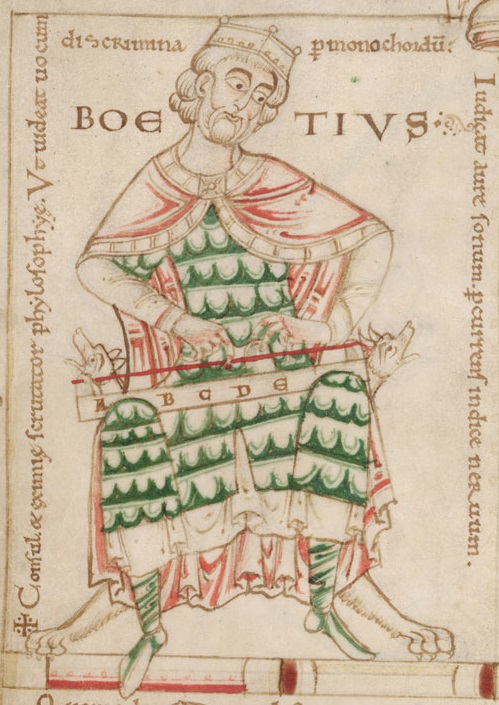
In Wednesday’s post I said I was surprised to find that I hadn’t shared Dryden’s “Song for St. Cecilia’s Day” before. I’ve just come across a post I started writing early last summer and never posted, and I mentioned the poem there. It’s only a fragment, and I don’t remember where I’d planned to go with the post, but I’m going to share it anyway.
~*~ ~*~ ~*~
My friend Esther and I have been reading the classic Introduction to Arithmetic by Nicomachus of Gerasa, who lived about a century after Christ. In the last chapter of the book he discusses the relationship between numbers which he calls, following Pythagoras, Plato, and Aristotle, the harmonic proportion.
Harmony is a three dimensional number and “is most useful for all progress in music and in the theory of the nature of the universe.”
The ancient philosophers, and the medievals after them, believed that the motion of the cosmos was musical in nature.
In his discussion, he uses the word “diapason,” which I learned from John Dryden’s poem, “A Song for St. Cecilia’s Day, 1687.” Here is the first stanza:
From harmony, from Heav’nly harmony
This universal frame began.
When Nature underneath a heap
Of jarring atoms lay,
And could not heave her head,
The tuneful voice was heard from high,
Arise ye more than dead.
Then cold, and hot, and moist, and dry,
In order to their stations leap,
And music’s pow’r obey.
From harmony, from Heav’nly harmony
This universal frame began:
From harmony to harmony
Through all the compass of the notes it ran,
The diapason closing full in man.
In C.S. Lewis’s creation myth in The Magician’s Nephew, Aslan sings Narnia into existence. J.R.R. Tolkien’s creation myth in The Silmarillion is part of this tradition, too: Eru Iluvatar’s creates the Ainur from his own thoughts, and their songs after Iluvitar’s pattern bring everything else into existence.
Lewis’s version, being written for children, is the simpler, more straightforward one—everything in Narnia is made by Aslan. But Tolkien’s is an image not only of God the creator, but of Man, made in his image, acting as sub-creator, following the pattern of order, harmony, beauty.