Showing posts with label math. Show all posts

Friday, October 25, 2024

Mathematics and harmony


In Wednesday’s post I said I was surprised to find that I hadn’t shared Dryden’s “Song for St. Cecilia’s Day” before. I’ve just come across a post I started writing early last summer and never posted, and I mentioned the poem there. It’s only a fragment, and I don’t remember where I’d planned to go with the post, but I’m going to share it anyway.


~*~ ~*~ ~*~


My friend Esther and I have been reading the classic Introduction to Arithmetic by Nicomachus of Gerasa, who lived about a century after Christ. In the last chapter of the book he discusses the relationship between numbers which he calls, following Pythagoras, Plato, and Aristotle, the harmonic proportion.

Harmony is a three dimensional number and “is most useful for all progress in music and in the theory of the nature of the universe.”

The ancient philosophers, and the medievals after them, believed that the motion of the cosmos was musical in nature.

In his discussion, he uses the word “diapason,” which I learned from John Dryden’s poem, “A Song for St. Cecilia’s Day, 1687.” Here is the first stanza:


From harmony, from Heav’nly harmony

               This universal frame began.

       When Nature underneath a heap

               Of jarring atoms lay,

       And could not heave her head,

The tuneful voice was heard from high,

               Arise ye more than dead.

Then cold, and hot, and moist, and dry,

       In order to their stations leap,

               And music’s pow’r obey.

From harmony, from Heav’nly harmony

               This universal frame began:

               From harmony to harmony

Through all the compass of the notes it ran,

       The diapason closing full in man.


In C.S. Lewis’s creation myth in The Magician’s Nephew, Aslan sings Narnia into existence. J.R.R. Tolkien’s creation myth in The Silmarillion is part of this tradition, too: Eru Iluvatar’s creates the Ainur from his own thoughts, and their songs after Iluvitar’s pattern bring everything else into existence.

Lewis’s version, being written for children, is the simpler, more straightforward one—everything in Narnia is made by Aslan. But Tolkien’s is an image not only of God the creator, but of Man, made in his image, acting as sub-creator, following the pattern of order, harmony, beauty.

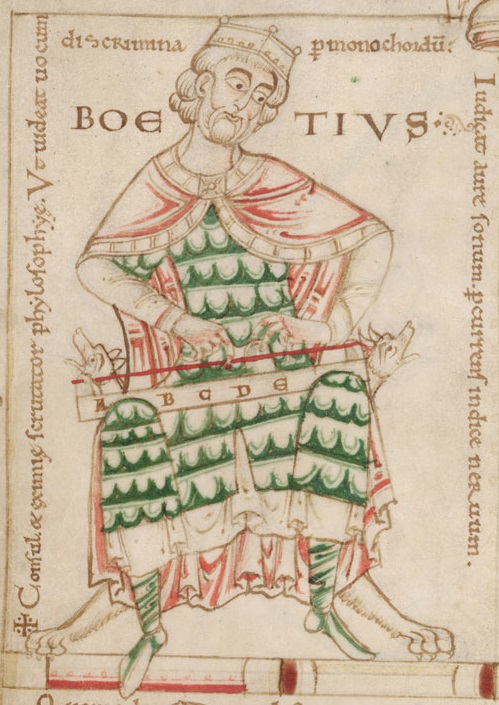
Wednesday, October 23, 2024

From Harmony this universal frame began*

Boethius playing the monochord
Anonymous,
Cambridge, University Library
Public Domain
Link

“Pythagoras and his followers devoted a great deal of attention to acoustical and musical phenomena. They regarded consonances—especially of a fourth, fifth, and octave—as models of that harmony, conceived of as an accord or equilibrium of different elements, which they equated with the human soul or with the ordering principle of the universe. The assignment of the numerical ratios that are at the basis of musical concordances was for the Pythagoreans the starting point for discovering the laws which governed both the feelings of the soul and the movements of the universe. They arrived at these results experimentally, through the monochord, whose invention was attributed to Pythagoras himself.”

 ~Music in Greek and Roman Culture, by Giovanni Comotti (tr. Rosaria V. Munson)


~*~ ~*~ ~*~


*I just realized I’ve never shared John Dryden’s “Song for St. Cecilia’s Day” here, which is a horrible oversight. Do read it—it’s so beautiful and fairly sums up the medieval understanding of how the order of the entire cosmos is a musical relationship.

Tuesday, April 27, 2021

Math resources -- philosophical

I've been collecting titles for several years now and people frequently ask me what they can read to help them on their own math journey, so I'm going to be adding to this series, or maybe created a page with the master list or something like that -- I don't really have a plan in mind beyond sharing resources in one place that's easier to find than searching through old Facebook posts.


First up is the essay that radically changed my perspective on math. I used to say, when asked what my favorite subject was, that I loved everything except math. I said this because by the time I was in 6th grade I'd decided that I simply couldn't do math, that I wasn't a Math Person, that I was a lost cause. My goal in math class from that point on was not to get an F and have to repeat the class.

Reading this essay infuriated me. I remember how much I loved playing with numbers and patterns as a child and how easy 1st through 3rd grade math was for me, but 4th grade math was the first time I encountered things I didn't understand and when I asked for an explanation, there was NONE. By the time I was in 6th grade . . . honestly, looking back on it I feel like I was brainwashed into believing that math was memorizing and working formulas, which I was no good at. 

This is a lot like my school experience of history, which I was good at, but didn't particularly love, because school history was memorizing names and treaties and nations and so forth. I could do that. It honestly wasn't until I was in my second semester of college that I connected all the biographies and memoirs and accounts of life long ago that I loved so much to HISTORY. I kind of feel like an idiot admitting that, but really what happened inside of school was for the most part disconnected with me reading books I loved and learning all the things I loved learning about.

So. 

Start here.

A Mathematician's Lament, by Paul Lockhart 

That link will download a PDF. Lockhart later wrote a book of the same title that incorporates this essay. I've read it, and don't really think it adds anything of substance to this free essay.

Tuesday, March 23, 2021

The Sieve of Eratosthenes

Somewhere in my past I learned about the Sieve of Eratosthenes – it was presented as a method for finding out prime numbers. The end.

In my last reading of Introduction to Arithmetic, Nicomachus mentioned the sieve in Book 1 chapter 13 when talking the relationships between odd numbers, specifically finding out whether any two numbers have a measure in common with one another. We would call this a “common denominator.” Nicomachus says there are three classes of odd numbers, which I won’t go into here because it’s complicated, but he introduces the sieve as a method for producing the three classes, and finding out their “common measure” at the same time. When you mark each odd number as he suggests, their relationships appear.

I stopped at 31 because I was running out of ideas for symbols ;-)

I was taught simply to start with 3 and cross out any number that was divisible by 3, then move to 5 and do the same. This means that you’ll skip over 15 and 45 because they were crossed out when you were doing 3s. Then you do the same with 7, 11, 13, and so on (you skip 9 and all the rest of the numbers you’ve already crossed out). After a while, the numbers you’re left with are the primes – the ones that aren’t divisible by anything other than 1 and themselves.

Doing it Nicomachus’s way is so much richer though, because you’re not just solving a single problem – you’re noticing the relationships between the numbers, and that’s what Arithmetic really is. Not just performing operations with symbols, but understanding the relationships with the reality beyond the symbols.

Saturday, March 13, 2021

My math collection


I haven't done a math post in ages! Several years ago I got really busy with other studies and had to set my math studies aside, but I've been able to take them up again recently, reading Introduction to Arithmetic by Nicomachus of Gerasa with my friend Esther, who blogs at Dappled Things. She suggested I return to the topic here and I have a few ideas for future posts, but in the mean time I thought I'd share a peek at my shelves, and mention a few favorite titles.

My youngest is a senior this year and is using The Teaching Textbooks, so a lot of these books and games are things we used when she and her siblings were a lot younger, but I've kept them out because I still refer to them from time to time.

The middle shelf is mostly manipulatives and decks of cards. The basket is full of Math-U-See blocks. The cardboard box has pattern blocks. We hardly ever use the manipulatives any more -- they're just here because I don't want them separated from everything else. We don't really play "math games" much any more either, but we do play card games sometimes. The white bottle in the red sleeve is a bottle full of pennies for using when we play our family's favorite card game, Continental. 


The top shelf is mostly books for my own study and use. I pulled the Ruth Beechick book out so you can see it better. It's just a tiny thing, but so important. If you're just getting started, I can't recommend it enough. Behind it are the textbooks and CDs I got from The Teaching Textbooks, when we were doing it that instead of using their subscription service. Asimov's Realm of . . . books are kind of a history of the development of math. They make great read alouds with middle school and older kids, if taken in fairly small doses. Give you lots to talk about. 


The bottom four are books for me on child development and teaching as it relates to math. The top four are Denise Gaskins' excellent series of math games for all ages. The yellow one is a program that I started then abandoned -- it seems like it would be really good for young kids but I got it too late to use with my younger set. I'm thinking I should revisit it with my special needs son, and see if he takes to it. It starts with counting on the fingers, based on some interesting brain science -- there's actually a part of the brain that connects the fingers with numbers. The ones on the right are all "living" math books -- a few biographies, a history of counting. Picture books for younger kids but still very interesting.


Bottom, three ancient college textbooks -- I don't remember where they came from. The blue paperback is the text to a Great Courses class I took several years ago. Standing on top of the stack is Horace Grant's Arithmetic for Young Children, out of print, but an excellent resource. It's standing on his Second Stage of Arithmetic, also excellent and out of print -- I sent the google doc of the book to a custom printing service and got it that way, which wasn't as expensive as it sounds. The only other option would have been to print and bind it myself and I didn't want to spend time on all the formatting. The colored books are Life of Fred, which are fun and helpful.

See my math label for earlier posts describing some of the things I was doing with my children and learning on my own.


Monday, May 20, 2019

PLAY is the first stage of a mathematical education


Astronomy is the capstone of the Quadrivium because it is number in time and space, which is to say that the whole cosmos is a dance, which is a form of play.

In Laws VII (819) Plato tells us, when the Athenian is describing how children should be taught the fundamentals of mathematics, that it is best to imitate the Egyptians. “In that country,” he says, “arithmetical games have been invented for the use of mere children, which they learn as a pleasure and amusement.”

Most of our traditional childhood games are of this nature. There are the obvious games involving cards and dice where you have to count and keep score, and games like jacks, hopscotch, and jump-rope that require not only counting but physical movement.

Still less obvious are the nursery games that parents play with their children. Many of these involve rhythm and movement, such as “Pat-a-cake, pat-a-cake baker’s man.” Something mind-blowing that I learned recently is that there’s a part of the brain that specifically links your fingers to numbers. Think of the finger game that we sing with our babies “Where is Thumbkin?” When I sang that to my babies, if I thought of it as anything educational at all, I thought of Object Permanence. But when we have our little ones make their own hand motions to that song we’re giving them a physical skill that will translate to physically preparing their brains for a deep understanding of Number.

Here’s another one that lays the groundwork for mathematical thinking—Twenty Questions. When you ask the first question, “Animal, vegetable, or mineral?” you’re asking about categories, and then the second question, “Is it bigger than a breadbox [or microwave for most of us nowadays]?” asks a comparison question that is mathematical in nature.

The only curriculum I’ve ever seen that’s even remotely close to this understanding, is the out of print book by Horace Grant, Arithmetic for Young Children. In that book, he has the students use a collection of objects to play with Number, presented in an orderly fashion. Along with this, he asks questions that spark the imagination and help the child make the leap to mental math. Formal, written arithmetic is delayed until the book Second Stage of Arithmetic, and is introduced along with having the child think through numeration (why we name amounts the way we do) and notation (why we write numerals the way we do). It’s a brilliant presentation, which is begun around ten to twelve years of age, far later than most of are comfortable with, used as we are to rushing academics, but I think it’s developmentally appropriate.

Another resource I recommend highly is Denise Gaskins’ Let’s Play Math website and book series. They’ll give you lots of ideas of things you can do to prepare your child for the formal study of the Quadrivium.

I haven’t used this finger math curriculum with young children (I’m generally against formal lessons for children under six or seven years of age), but it seems to fit my qualification of playful. I suspect it might work for older students who may have missed all these games and may need remedial arithmetic.

Friday, March 25, 2016

Cyphering books

In my casual research on mathematics and its teaching I came across something interesting -- I'm just sharing it here in order to keep track of it myself, and to offer it up to anyone else who may be interested.

I found the latest fragment in a book called Rewriting the History of School Mathematics in North America 1607-1861: The Central Role of Cyphering Books, which I will probably never buy because it costs over $100. 

O.o

A cyphering book is something like a copy book, only for rules of computation and examples of how each rule works, plus exercises which the student solved himself. Each student wrote out his own cyphers in his own notebook, copied from work the teacher gave him. The cypher book was intended to serve him the rest of his life as a reference manual.

A page from Abraham Lincoln's cyphering book

Back to Rewriting the History . . . . It turns out that something I had been suspecting is true -- which is not surprising, because there's nothing at all revolutionary about it, but it's always fun to find actual proof -- and that is this: The way we teach arithmetic today has more to do with book-keeping than with mathematics.

Remember last summer when I mentioned that the ancient Greeks made a distinction between arithmetic and logistics? Logistics is skill in computation for practical purposes. There is nothing at all wrong with teaching logistics. After all, we want our kids to be able to function in our society, so of course they need to know how to keep a budget, how to double or halve a recipe, how to buy enough paint or carpet or lumber for a project, how to figure out what kind of insurance they need, or whether they can afford a mortgage, and all those things. Many of our kids will need more complicated math for programming computers or analyzing data. So I'm not saying we classical/CM educators shouldn't teach our kids that kind of math.

But I do think it's lopsided for that kind of math to make up the bulk of our curriculum.

The bit of Rewriting History that's available for viewing on Google gives a rough of idea of the development of the modern situation.

Beginning in the 1200s, trade between city-states and republics proliferated to the extent that successful merchants needed to hire skilled "reckoners" to calculate profits, predict risks and control losses, figure weights and measures, deal with simple and compounding interest, keep track of partnerships, and all kinds of complicated things. 

As demand for this skill increased, reckoning schools sprang up around Europe. But get this. Boys of ten or eleven years of age would be sent there for a two-year course which prepared them for work in the actual business. And they didn't have calculators.

Of course, the universities were still concerned with the mathematics as liberal arts, and the book goes on to describe the changing attitudes there, but that's the extent of what I can read online for free.

Maybe I should as for this book for Christmas.

:-D