Showing posts with label marginalia. Show all posts

Tuesday, August 15, 2023

Of knights and snails

One the funnest parts of looking at medieval art is running across an illustration of a knight fighting a snail. 


There are many theories as to what these snails are doing in the art, but not a one of them matches my own, which I came up with this year while reading through the Psalms with my family. Take a look at this:

Psalm 58

1 Do ye indeed speak righteousness, O congregation? do ye judge uprightly, O ye sons of men?
2 Yea, in heart ye work wickedness; ye weigh the violence of your hands in the earth.
3 The wicked are estranged from the womb: they go astray as soon as they be born, speaking lies.
4 Their poison is like the poison of a serpent: they are like the deaf adder that stoppeth her ear;
5 Which will not hearken to the voice of charmers, charming never so wisely.
6 Break their teeth, O God, in their mouth: break out the great teeth of the young lions, O Lord.
7 Let them melt away as waters which run continually: when he bendeth his bow to shoot his arrows, let them be as cut in pieces.
8 As a snail which melteth, let every one of them pass away: like the untimely birth of a woman, that they may not see the sun.
9 Before your pots can feel the thorns, he shall take them away as with a whirlwind, both living, and in his wrath.
10 The righteous shall rejoice when he seeth the vengeance: he shall wash his feet in the blood of the wicked.
11 So that a man shall say, Verily there is a reward for the righteous: verily he is a God that judgeth in the earth.


The psalmist is describing how ferocious and dangerous the enemies of God appear, but then in verse 8 he says, "As a snail which melteth, let every one of them pass away."

In other words, they appear unconquerable, but they really aren't. 


The popular idea about this image is that the knight has given up and is begging mercy of the victorious snail, but I believe he has recognized that this is spiritual warfare, so he has laid down his sword and is praying to God for deliverance.

What's your favorite theory?

Tuesday, February 2, 2021

Badgers


 “I’m a beast, I am, and a Badger, what’s more. We don’t change. We hold on.” 

This is Trufflehunter in CS Lewis’s Prince Caspian, explaining to Nikabrik the dwarf why they must protect Caspian and restore him to his rightful throne: “Narnia was never right except when a son of Adam was King.” 

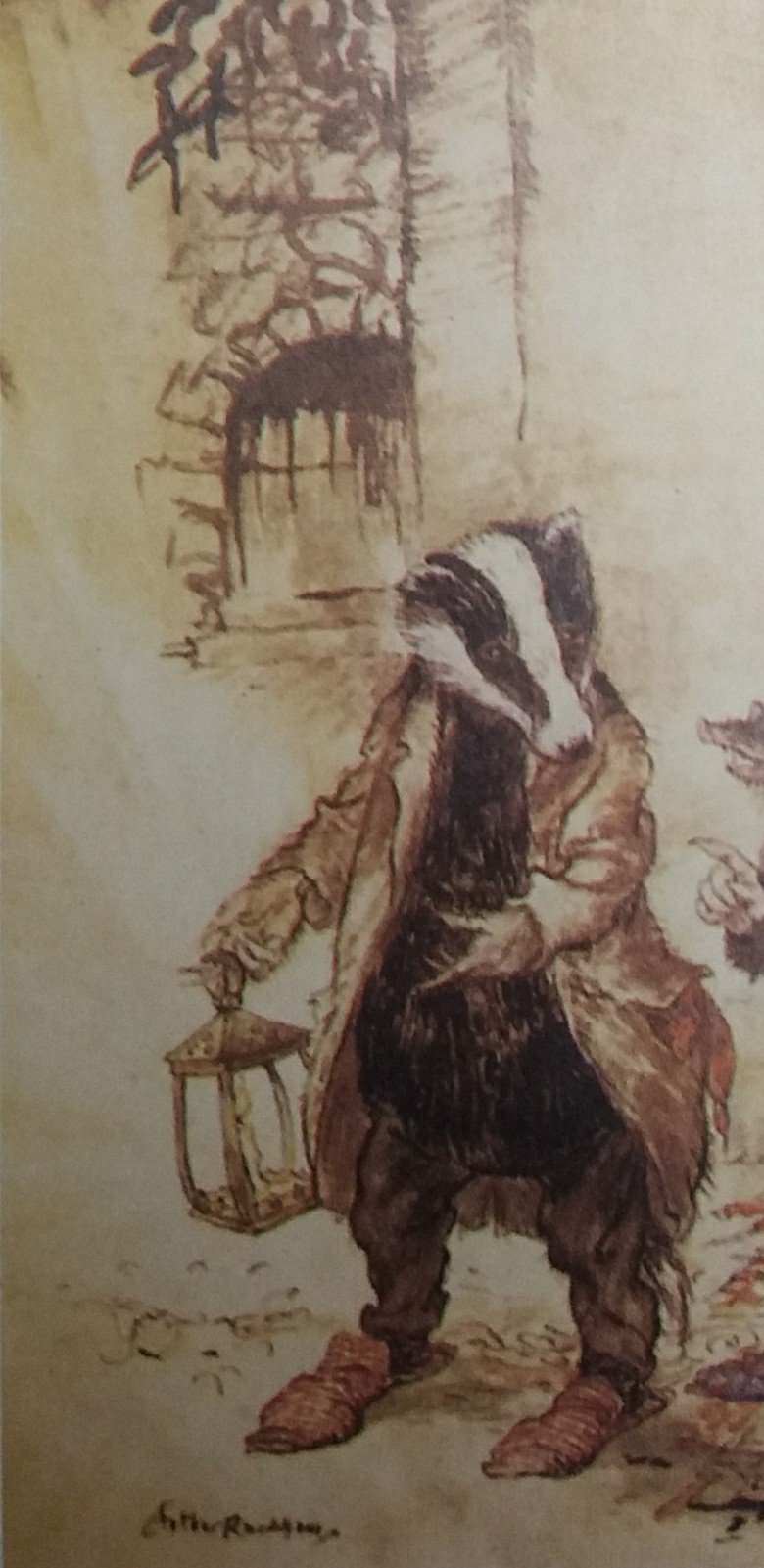
Yesterday morning I was listening to Numbers chapter 4 and noticed how often badgers’ skins were mentioned. Over and over, as the tabernacle and its contents are described, it mentions a covering of badgers’ skins—seven times, in fact. 

It’s not an accident that Trufflehunter and Mr Badger (from The Wind in the Willows) are the way they are. They endure. They protect the holy things.

Saturday, November 7, 2020

Random thoughts while reading The Divine Comedy


 In her introduction to Hell, Dorothy Sayers quotes a passage from Dante’s Vita Nuova where he describes how he felt the first time Beatrice ever spoke to him. “Dante is describing the effect upon him of Beatrice’s ‘salutation’; and it should be remembered that the Italian word salute means not only ‘salutation’ but also ‘salvation’.” Think now of how Charlotte greeted Wilbur in Charlotte’s Web. “Salutations!”

Moving through the Cantos of Inferno, I got the distinct impression we were moving through the celestial spheres—or rather through an infernal reflection of the spheres. That shouldn’t have surprised me, but it did.

I kept wondering why this is called a Comedy when it feels more like a Romance, then I noticed Anthony Esolen’s footnote to I.XVI.129: “For writers of the Middle Ages, a comedy is a song written in humble style . . . wherein the main character begins in grief and trouble and ends in happiness.” It’s good to be aware that terminology has changed over the centuries.

Friday, May 18, 2018

Notes on reading The Faerie Queene the second time

When writing an essay, it’s common to arrange your Proof section first (that’s the body of the essay), then you work out your Conclusion, then you decide on your Introduction, including the Exordium, which is supposed to raise the reader’s interest and give him a clue as to the content of the essay.

While reading The Iliad this school year, I noticed that Book I serves as the Exordium for the whole work. The events in that book foreshadow the events of the whole story. Then I began noticing that the first few lines of each book serve as the exordium for that book. There’s a fractal pattern to the whole work.

When the kids and reread Book I of FQ last month, I suddenly realized that Cantos 2-6 foreshadow what is going to happen in Books 2-6. I also noticed that Canto 1 is an exordium for the whole of Book I, and the first few stanzas of each canto are the exordium of that canto.

Now we’re in Book II, and I’m seeing the same pattern. We just finished Canto 6, and Sir Guyon is able to disengage himself from a bad woman while maintaining a courteous demeanor. Guess what? Book VI is the story of Sir Calidore, the knight of courtesy.


Illustration by A.G. Walker in
Stories from The Faerie Queene, by Mary Macleod

This work is genius, y’all. You need to read it. More than once, too.


Saturday, November 1, 2014

How to write

This morning I read this excellent little article on writing successfully (which is different from writing well, as the author points out), and because I'm also reading Karen Glass's wonderful book, Consider This, in which is stated more than once that knowing something and doing it are two different things, and that knowing and doing the right thing is the definition of virtue, and virtue, of course, is the point of a classical education, and because this is National Novel Writing Month and, though I've participated two or three times I've never come close to finishing anything, I decided to follow the advice in the article, which can be boiled down to "Just write."

His article is much more helpful and practical than that, of course, and you really ought to read it.  It won't take more than five minutes and he's funny.

I am determined to do this exercise every day this month, so just for fun, here is today's effort.  And I promise I won't post any more of these.


Tuesday, September 16, 2014

So, this is what I did instead of nature notebook


Motifs found at Tangle Patterns, chosen because they reminded me of the florets on the sunchoke flowers.

Trying to give my children something to imitate . . .


Inspired by Silvia's latest post on nature journaling, when I took my walk this afternoon, I took lots of pictures of the Jerusalem artichokes, which are in their glory now and brought in one flower, so I could sketch it.


I stared at this flower for several minutes trying to figure out where to begin.  It's a LOT more complicated than I'd realized, and I'm not at all good at drawing what I see.  Finally I decided to draw just one petal . . .


. . . and while I was staring at the flower I noticed that all that complicated stuff in the center was made up of curlicues like this:


Then I noticed that each curlicue was growing out of a tiny flower like this:


Ah!  Now I remember -- Jerusalem Artichoke is a relative of the sunflower, so this is a compound flower.

The bees love it


[And by "something to imitate" I mean the habit of paying close attention and keeping a nature journal.  They can all draw a whole lot better than I can!]


Tuesday, September 2, 2014

Fresh paint

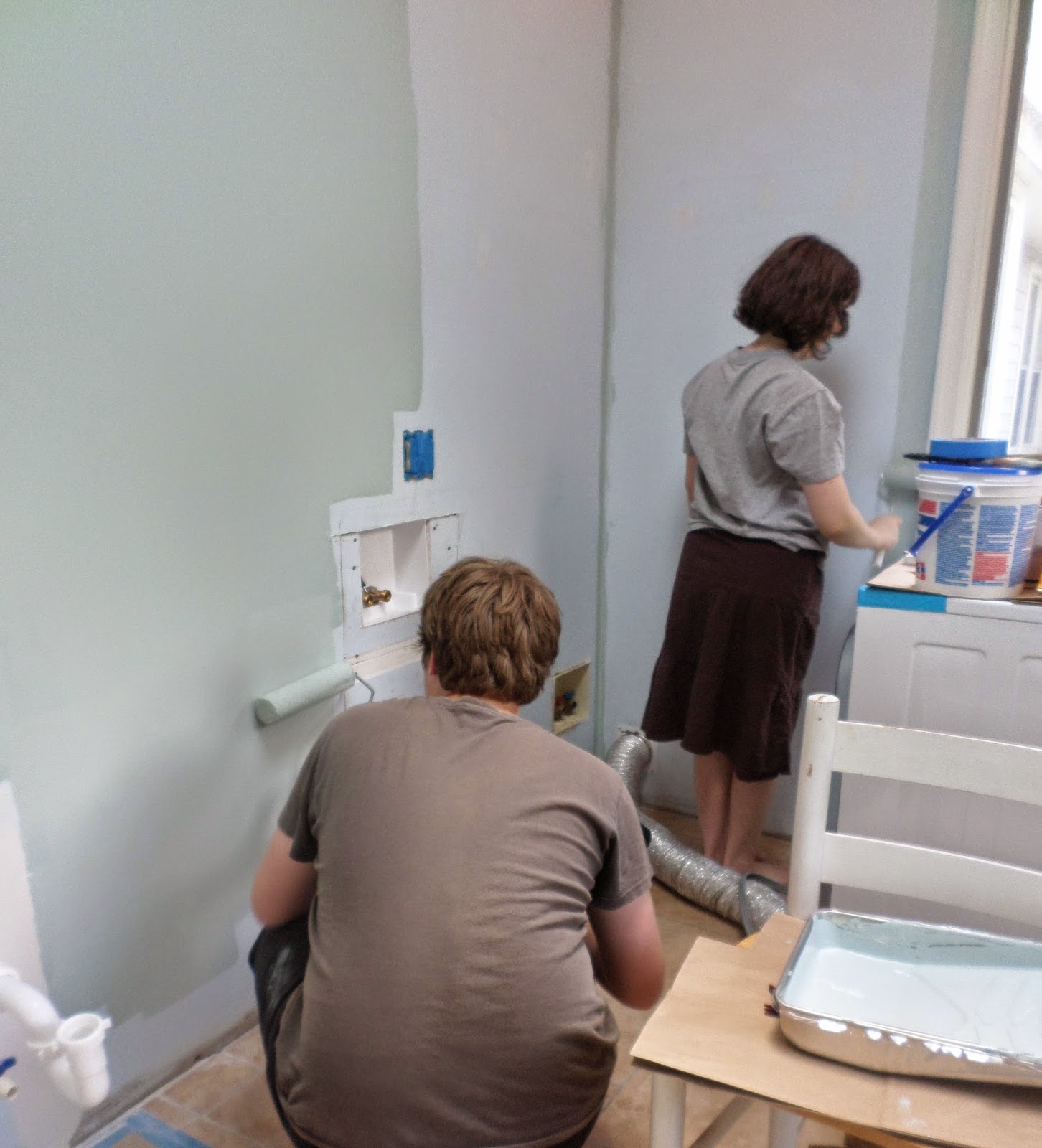
This is the color we're using for our new laundry room. It's kind of a robin's egg blue, and you can see in the pictures below how it changes color a bit depending on the light.  I love colors that do that -- more blue in some lights, more green in others.


When you read advice on choosing paint, you're usually told that the color will be much more intense on the wall than it is on the little paint card, so you should decide on which shade you like, then use the one that's one step lighter than that.


It doesn't work that way for me. I guess I'm afraid of getting too intense a color, so I naturally pick something that's lighter than what I'd really want. And then I put it on and I'm always disappointed with it.


But this time I ignored the advice and bought the color I liked best.


And this time the color is perfect.

Sunday, July 1, 2012

Right brain or left brain?

Dana posted this quiz and asked her readers to let her know which they are, so I played along -- generally speaking, I love this sort of thing.

I found it a hard test, though. There were a few questions that I could have answered either way, just depending on the circumstances -- the one about whether you prefer to work alone or in a group, for example. For me that depends on the nature of the work. So I answered all the questions and got this result:

Which Side of your Brain Do You Use?
Your Result: Right Side
 

The right brain however, processes from whole to parts. You see the big picture first, not the details. You are however not good at spelling, math, and science. Problem solves with hunches, looking for patterns. You are good at sports and writing. You have an imagination which is good because when you have imaginatin you tend to be more smart. You prefer working in a group than by yourself. You also like to read fantasy and mystery stories. You can also listen to music or TV while studying. You perfer having fun than work. You also think better when lying down! I am a right sided person many people are right sided so you are normal.

Left Side
 
Which Side of your Brain Do You Use?
Quiz Created on GoToQuiz

Then I answered it again, changing those iffy ones, and got this result:

Which Side of your Brain Do You Use?
Your Result: Left Side
 

The left side of the brain processes information in a linear manner. It processes from part to whole. It takes pieces, lines them up, and arranges them in a logical order; then it draws conclusions. You look at the details not the big picture. You use logic not imagination. The left brained person is a list maker. You would enjoy making master schedules and and daily planning. Learning things in sequence is easy for you. You are probability a good speller. Left-brained people memorize vocabulary words or math formulas better. You also use logic. When you read and listen, you look for the pieces so that you can draw logical conclusions. The left side of the brain deals with things the way they are-with reality. When left brain students are affected by the environment, they usually adjust to it. Left brain people want to know the rules and follow them. So basicly you are smart! Congratulations!

Right Side
 
Which Side of your Brain Do You Use?
Quiz Created on GoToQuiz

Neither one of them really describes me.

I am a whole-to-parts, big picture person (Right brain), but I'm good at spelling and I love science and was good at it in school (Left brain). I'm sure that the only reason I did so badly at math is because of the way it was taught -- thousands of details and formulae and operations, and no big picture at all, and I love math games and playing with numbers (Right brain).

I love drawing up master schedules and making plans (Left brain) but I loathe working with details (Right brain). I always loved vocabulary word lists and I'm horrible with figures of speech (Left brain), but I love fantasy stories, fairy tales, and mysteries (Right brain).

I absolutely cannot listen to music or watch TV while studying or reading, or doing anything at all for that matter (except maybe fold towels) (Left brain), but now that they mention it, I do think better while lying down and that's my preferred position for reading (Right brain).

Do I prefer fun to work? Hm. I don't think so, but I think some work really is fun, and I do prefer the work when there's some fun involved -- "fun" for me being having an interesting conversation while working -- but it seems like everyone is like that; it just depends on how you define fun. On the other hand, I can have fun (read books with my children, have interesting conversations, listen to beautiful music, watch movies) in the face of lots of neglected work without it bothering me too much (Right brain-ish).

Do I want to "know the rules and follow them"? Lots of times, yes, especially when it's an area where there's received wisdom and I see no reason to waste time re-inventing the wheel. I read the instructions, and I hate instructions that are only pictures (Left-brain).

Problem-solving is a joke. Early on I learned that only Stupid, Irrational, Bleeding-heart Liberals follow their hunches and Smart Sensible People use logic, so that's the method I use, but because I'm so bad at details I always overlook important data and come to wrong conclusions. I see things in terms of patterns and more often than not my hunches are correct, so I'm trying to learn to pay more attention to them. For some reason my head and my heart are not on speaking terms with one another.

My favorite line from Henry V is "I and my bosom must debate awhile."

So, how about you? Are you Left-brain, Right-brain, or somewhere in the middle?