Saturday, March 13, 2021

My math collection


I haven't done a math post in ages! Several years ago I got really busy with other studies and had to set my math studies aside, but I've been able to take them up again recently, reading Introduction to Arithmetic by Nicomachus of Gerasa with my friend Esther, who blogs at Dappled Things. She suggested I return to the topic here and I have a few ideas for future posts, but in the mean time I thought I'd share a peek at my shelves, and mention a few favorite titles.

My youngest is a senior this year and is using The Teaching Textbooks, so a lot of these books and games are things we used when she and her siblings were a lot younger, but I've kept them out because I still refer to them from time to time.

The middle shelf is mostly manipulatives and decks of cards. The basket is full of Math-U-See blocks. The cardboard box has pattern blocks. We hardly ever use the manipulatives any more -- they're just here because I don't want them separated from everything else. We don't really play "math games" much any more either, but we do play card games sometimes. The white bottle in the red sleeve is a bottle full of pennies for using when we play our family's favorite card game, Continental. 


The top shelf is mostly books for my own study and use. I pulled the Ruth Beechick book out so you can see it better. It's just a tiny thing, but so important. If you're just getting started, I can't recommend it enough. Behind it are the textbooks and CDs I got from The Teaching Textbooks, when we were doing it that instead of using their subscription service. Asimov's Realm of . . . books are kind of a history of the development of math. They make great read alouds with middle school and older kids, if taken in fairly small doses. Give you lots to talk about. 


The bottom four are books for me on child development and teaching as it relates to math. The top four are Denise Gaskins' excellent series of math games for all ages. The yellow one is a program that I started then abandoned -- it seems like it would be really good for young kids but I got it too late to use with my younger set. I'm thinking I should revisit it with my special needs son, and see if he takes to it. It starts with counting on the fingers, based on some interesting brain science -- there's actually a part of the brain that connects the fingers with numbers. The ones on the right are all "living" math books -- a few biographies, a history of counting. Picture books for younger kids but still very interesting.


Bottom, three ancient college textbooks -- I don't remember where they came from. The blue paperback is the text to a Great Courses class I took several years ago. Standing on top of the stack is Horace Grant's Arithmetic for Young Children, out of print, but an excellent resource. It's standing on his Second Stage of Arithmetic, also excellent and out of print -- I sent the google doc of the book to a custom printing service and got it that way, which wasn't as expensive as it sounds. The only other option would have been to print and bind it myself and I didn't want to spend time on all the formatting. The colored books are Life of Fred, which are fun and helpful.

See my math label for earlier posts describing some of the things I was doing with my children and learning on my own.


Tuesday, February 23, 2021

The Divine Comedy and The Tempest

One of the fun things about having several books going at once is that it makes it easier for you see connections between them.

This morning I was reading Dorothy Sayers’ commentary on her translation of Purgatory. She describes the difference between the retributive punishment the characters undergo in Inferno as being very similar to the remedial punishments suffered by those on Mount Purgatory. The difference, she says, lies not in the nature of the suffering, but in the character of the sufferer. In Inferno, the people there have chosen their sin to the very end and so have no remorse – they do not accept the justice of their punishment, so the punishment can do them no good. On the contrary, those in Purgatory are there because they sincerely want to do the will of God and to be with him. They accept justice and “welcome the torment, as a sick man welcomes the pain of surgery” (p. 16). And they don’t just accept the suffering – they “count it all joy.”

Now, I’m a Protestant and don’t believe in Purgatory as a real state after death, but that doesn’t stop us from appreciating the story and from seeing what this means as an allegory of the soul. If we love and seek God, then the suffering we encounter in life is part of the refiner’s fire, and is for our good.

Then, this afternoon, I was rereading The Tempest to prepare for a co-op class I’ll begin teaching soon. In Act 2, a group of shipwrecked men are wandering around trying to find the rest of their companions. To one of these four men, Gonzalo, the island they find themselves on is a Paradise, or can easily be made one, but to the other three it’s “Uninhabitable and almost inaccessible,” with air that stinks of a swamp. The main difference between these men? Gonzalo is a faithful friend and counsellor, where his companions are all traitors and usurpers, “three men of sin,” as they’re called later in the play.

Not a perfect parallel, but it helped me make sense of what’s going on in that scene and another one that follows later, when the three men have a horrific vision, where Gonzalo sees and enjoys a banquet. The last time I read The Tempest I thought Gonzalo must be a lunatic.

Saturday, February 13, 2021

The Faerie Queene


This is the Folio edition,
illustrated by Walter Crane,
which my family gave me
for Christmas a few years ago

Those of you who have followed me for any length of time at all know that I adore Spenser’s epic romance, The Faerie Queene (check out my Faerie Queene label for past posts on it) I’ve mentioned loving it and reading it aloud to my own children, who also love it, so many times that people finally started asking me to teach it to them so they could read it and love it too.

Starting next August I’ll be teaching a year-long online class through House of Humane Letters. While all adults and high school aged students are welcome, I’ve designed the class especially with the homeschooling mom in mind, so we’ll be meeting in the evenings and following a schedule that’s looser than the traditional school year.

For each of the six books, I’ll have one introductory lesson, then we’ll read the book’s twelve cantos over the course of four weeks, then take a break before starting the cycle over again with the next book. All classes are recorded, so if you aren’t able to make the live class, you can watch the recordings and take things at your own pace.

Registration begins March 1 for families new to House of Humane Letters and will be conducted via email, so if you’re interested, go to House of Humane Letters and sign up for their email list.

Here’s my description of the class:

~*~ ~*~ ~*~

“From the time of its publication down to about 1914 [The Faerie Queene] was everyone’s poem—the book in which many and many a boy first discovered that he liked poetry; a book which spoke at once, like Homer or Shakespeare or Dickens, to every reader’s imagination.”

~ C.S. Lewis, Studies in Medieval and Renaissance Literature


The Faerie Queene along with its style of storytelling has been out of favor for so long that we encounter several difficulties (apart from its sheer size!) when trying to read it. Lewis identified three for us: its narrative technique, its allegory, and the texture of its language—that is, the kind of poetry it is, which affects how it’s to be approached.

In this class, I’ll not only give you the imaginative frame of mind for entering into Spenser’s masterpiece, I’ll help you with these three areas. Together we’ll become more comfortable with the polyphonic narrative style, which you may never have encountered before. We’ll discuss how to understand the story’s allegory as well as when to ignore it. We’ll learn to appreciate Spenser’s poetic style and I’ll teach you strategies for reading the poetry, whether to yourself or to your children.

And that really is my goal for this class—not just to help you read this magnificent story, but to give you the confidence to read it to your own children as I did to mine.


Recommended editions (affiliate links):

I have found three editions which I can recommend for this class. Every edition has the same system of numbering the cantos and stanzas, so we can each use the one that best meets our own needs.

The single-volume Penguin Classics edition edited by Thomas Roche is the one I use when I’m reading aloud because there are no notes in the text, which I find distracting. All of the notes, which are in the back, are fairly minimal, defining unfamiliar words and giving some Biblical, Classical, and literary explanation of Spenser’s allusions. All spellings are original, which includes many instances of swapping V and U, using I instead of J, and swapping I and Y. Examples: Vna for Una, Sansioy for Sansjoy, Ioue for Jove, Yuory for Ivory. It’s a little confusing at first, but you do get used to it. Includes all the commendatory verses, dedicatory sonnets, and Spenser’s letter to Raleigh explaining his plan when writing the story. No essays or study guides.

The Routledge Press edition, edited by A.C. Hamilton. This is a large single-volume edition. Extensive footnotes defining archaic words and explaining Spenser’s allusions. Includes all commendatory verses, dedicatory sonnets, and the letter to Raleigh. Includes a chronology of Spenser’s life and work, a helpful introduction to the work, an extensive bibliography, and a list and description of all the characters and where they first appear in the work. Retains original spellings as described above. This edition is best for the student who wants to go deeper in his study of the work. A.C. Hamilton is a reliable Spenser scholar.

The Hackett Classics edition in five volumes (Books 3 and 4 are in one volume), various editors. Footnotes are minimal, defining difficult words and giving brief explanations of the allusions. When dealing with more “adult” allusions in the text, these notes tend to be more explicit than the notes in either Penguin or Hamilton. The introductions and essays vary in quality depending on the editor—some are pretty good, some are downright awful, so this edition is best for the reader who isn’t interested those extra essays. The commendatory verses and dedicatory sonnets are missing, but each volume contains the letter to Raleigh. Each volume has its own introduction (not always sympathetic to the work), bibliography, list of characters, and a glossary of the most commonly used difficult words. This edition has slightly updated spellings: uses of U, V, I, J, and Y are all regularized and some word use standard modern spellings to avoid confusion, e.g. “bee” updated to “be” because it’s the verb, not the insect. [Individual volumes: Book 1, Book 2, Books 3 & 4, Book 5, Book 6 and the Mutability Cantos]

Tuesday, February 2, 2021

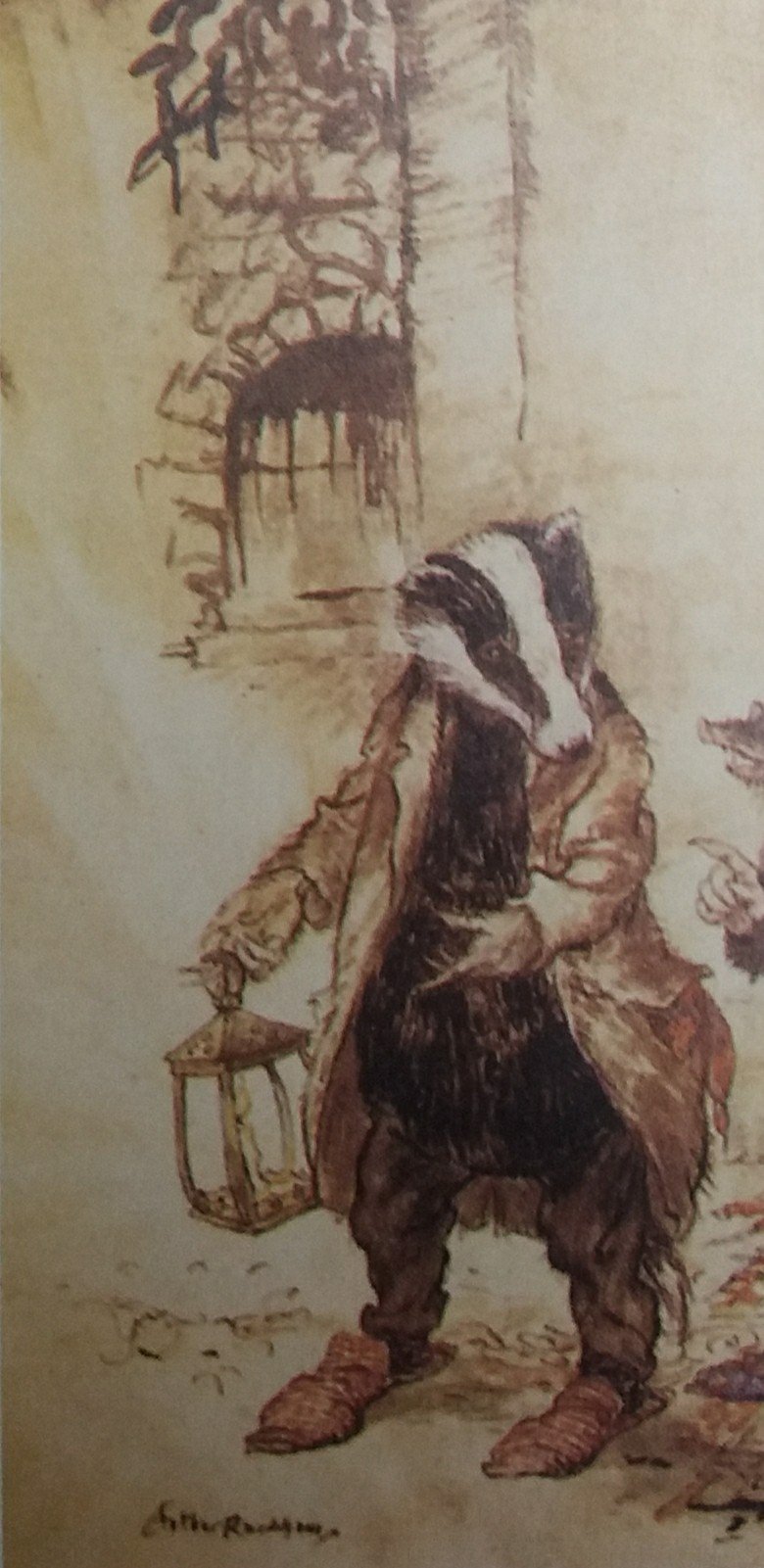
Badgers


 “I’m a beast, I am, and a Badger, what’s more. We don’t change. We hold on.” 

This is Trufflehunter in CS Lewis’s Prince Caspian, explaining to Nikabrik the dwarf why they must protect Caspian and restore him to his rightful throne: “Narnia was never right except when a son of Adam was King.” 

Yesterday morning I was listening to Numbers chapter 4 and noticed how often badgers’ skins were mentioned. Over and over, as the tabernacle and its contents are described, it mentions a covering of badgers’ skins—seven times, in fact. 

It’s not an accident that Trufflehunter and Mr Badger (from The Wind in the Willows) are the way they are. They endure. They protect the holy things.

Tuesday, January 26, 2021

Cedars


 I was reading Leviticus 14 this morning and was struck by the use of cedar wood to be burnt with certain offerings -- specifically those pertaining to being cleansed from leprosy, which is a kind of rot.

Here's what I know about cedar -- it's high in oil, which means that it's resistant to rot. You can cut down a cedar tree, lop off its branches, and use it for a fence post without having to cure it, which is why a LOT of old fence posts around pastures are cedar trunks. They'll last a long time just stuck in the ground like that.

Also, because of that oil content and how aromatic it is, certain bugs hate it, especially the kinds that get into your clothes and ruin them, like moths. This is why cedar chests are popular for storing sweaters, and if you have the resources for it, a cedar-lined closet is ideal.

All this reminds me of the passage that says, "Lay not up for yourselves treasures on earth, where moth and rust doth corrupt . . . "

Cedar being used the way it is, including in the Temple, seems to point us to the Resurrection where there will be no more death. 

Thursday, January 14, 2021

Winter rest


I was going to write a beautiful post about the gloriously busy holiday season and the need for rest before I go back to teaching again in February, but I’m too tired. The days are cold, and dark, and dreary. Nature is saying, “Rest,” so I will rest.

Thursday, December 3, 2020

Dappled Things

 My sweet friend Esther started a blog and named it after the same Gerard Manley Hopkins poem that my blog's title comes from. Check it out!


Tuesday, December 1, 2020

“Goblin Feet”

“The Meeting of Oberon and Titania,” Arthur Rackham (1908)
Wikimedia Commons


“Goblin Feet”
~ J.R.R. Tolkien (1892–1973)

I am off down the road
Where the fairy lanterns glowed
And the little pretty flitter-mice are flying:
A slender band of gray
It runs creepily away
And the hedges and the grasses are a-sighing.
The air is full of wings,
And of blundery beetle-things
That warn you with their whirring and their humming.
O! I hear the tiny horns
Of enchanted leprechauns
And the padded feet of many gnomes a-coming!

O! the lights! O! the gleams! O! the little tinkly sounds!
O! the rustle of their noiseless little robes!
O! the echo of their feet—of their happy little feet!
O! their swinging lamps in little starlit globes.
I must follow in their train
Down the crooked fairy lane
Where the coney-rabbits long ago have gone,
And where silvery they sing
In a moving moonlit ring
All a-twinkle with the jewels they have on.
They are fading round the turn
Where the glow-worms palely burn
And the echo of their padding feet is dying!
O! it’s knocking at my heart—
Let me go! O! let me start!
For the little magic hours are all a-flying.

O! the warmth! O! the hum! O! the colours in the dark!
O! the gauzy wings of golden honey-flies!
O! the music of their feet—of their dancing goblin feet!
O! the magic! O! the sorrow when it dies.


~*~ ~*~ ~*~

Written on 27-28 April 1915, shortly before leaving for the War, for his future wife who “loved tales of ‘spring and flowers and trees, and little elfin people.’”

Obviously this is nothing like his portrayal of elves and goblins that fans of The Lord of the Rings are familiar with and Tolkien himself later tried to distance himself from this very Victorian painting of the little people — in 1971 when he was asked permission to include “Goblin Feet” in an anthology, he said, “I wish the unhappy little thing, representing all that I came (so soon after) to fervently dislike, could be buried for ever.”

Tolkien’s first encounter with fighting was in France, in the Battle of the Somme, which is remembered as the bloodiest battle ever fought in history. On the first day of the battle nineteen weeks before Tolkien arrived, nineteen thousand British troops were killed. By the time the battle was over more than eight hundred thousand of the British had been killed.

[…]

Tolkien never forgot the brutality and horror of the battle. Many years later he drew on these memories to create his own lands. The blackened landscape of Mordor, and the Battle of Helm’s Deep were both based on The Battle of Somme.

(Information and quotes found at the Tolkien Library.)

 ~*~ ~*~ ~*~

This post first published April 17, 2008.

We watched 1917 (such a good movie!) a few days ago and it has me thinking about that war and especially how it changed the men who fought it. Tolkien was a very different man after the Great War, wasn’t he?

Saturday, November 7, 2020

Random thoughts while reading The Divine Comedy


 In her introduction to Hell, Dorothy Sayers quotes a passage from Dante’s Vita Nuova where he describes how he felt the first time Beatrice ever spoke to him. “Dante is describing the effect upon him of Beatrice’s ‘salutation’; and it should be remembered that the Italian word salute means not only ‘salutation’ but also ‘salvation’.” Think now of how Charlotte greeted Wilbur in Charlotte’s Web. “Salutations!”

Moving through the Cantos of Inferno, I got the distinct impression we were moving through the celestial spheres—or rather through an infernal reflection of the spheres. That shouldn’t have surprised me, but it did.

I kept wondering why this is called a Comedy when it feels more like a Romance, then I noticed Anthony Esolen’s footnote to I.XVI.129: “For writers of the Middle Ages, a comedy is a song written in humble style . . . wherein the main character begins in grief and trouble and ends in happiness.” It’s good to be aware that terminology has changed over the centuries.

Monday, August 10, 2020

Layers of meaning

I originally wrote the post below in April of 2019, but this past week I reread Macbeth for a class I’m teaching in Medieval cosmology and something new occurred to me this time through.

The story of the woman with the lap full of chestnuts can be looked at it from a different angle. A witch came to her wanting to take her blessings, and the woman, recognizing the evil creature, told the witch to leave, and she left. The witch attacked the husband’s ship, but she couldn’t do any permanent harm:

Though his bark cannot be lost,
Yet it shall be tempest-tossed.

Evil influences can be refused. Macbeth and his lady could have rejected their evil impulses, but they chose not to.

And in Medieval and Renaissance literature, those two meanings (this one, and the one in the post below) can both be true at the same time. In his Anatomy of Criticism, Northrup Frye calls this the “principle of manifold or ‘polysemous’ meaning.”

~*~ ~*~ ~*~


First impressions of Shakespeare's Macbeth, Act I, Scenes 1-5


That’s an awfully boring title, isn’t it? I couldn’t think of anything clever. :-p

The kids and I are reading Macbeth for our Medieval and Renaissance Literature class with Angelina Stanford, and I had some random things I wanted to write down before I forgot them, so here they are.


The Weird Sisters, Henry Fuseli, c. 1783


First Witch:
A sailor’s wife had chestnuts in her lap
And munched and munched and munched. “Give me,” quoth I.
“Aroint thee, witch,” the rump-fed runnion cries.
Her husband’s to Aleppo gone, master o’ th’ Tiger;
But in a sieve I’ll thither sail,
And, like a rat without a tail,
I’ll do, I’ll do, and I’ll do.

This sailor must be must be quite a man, given the trip he’s on, the ship he masters, and the fact that the Witch says she can’t sink his ship. She can, however, curse the husband of this foolish woman.

I’m saying she’s foolish because here she is with her lap full of blessings gobbling them so greedily that she won’t even share when an old woman asks for some.

If you know anything about fairy tales, you know that’s a huge mistake, a mistake of wicked stepmother proportions.

The chestnuts caught my attention though because so often the chestnut tree is used in literature as a symbol of happiness and prosperity. If you know anything about Macbeth, you know that this most definitely isn’t a story about happiness and prosperity.

Let me go back to the beginning.

The Tragedy of Macbeth opens with the stage direction, “Thunder and lightening. Enter three Witches.” These three make a plan to meet with Macbeth before the day is over (to tell him he will be king, as we later learn), and saying, “Fair is foul, and foul is fair,” they exit, and Scene 1 ends.

Given that the story begins with upheaval in nature, I’m going to assume that whatever disorder that set off this tragedy has already happened.

They reappear in Scene 3: “Thunder. Enter the three Witches.” The First Witch tells of her encounter with the sailor’s wife, which Asimov says has nothing at all to do with the play—it’s just there to please King James I, who “considered himself a particular expert on the matter of witchcraft,” and had “written a book called Demonology, in which he advocated . . . the severest measures against witches.” [Isaac Asimov’s Guide to Shakespeare: The English Plays, page 151]

Asimov, you’re a genius and I love you dearly, but you completely missed the boat on this one. Shakespeare wasn’t just a suck-up. He was an artist and he knew exactly what he was doing here.

(Before going on, I want to point out that these three are elsewhere in the play called the weyward/weird/wyrd sisters, so I think we’re supposed to think of them as being similar to the Fates of classical mythology, or the Norns of Norse mythology, priestesses who told the future.)

Now back to the chestnuts. Chestnuts provide a lot of nutrition and calories in a tiny little package, so they’ve always symbolised things like prosperity and fertility. Because they fall in such abundance during the harvest season, they also symbolise foresight and long life. Here’s something new I learned: They also symbolise the ability to receive ancient wisdom.

So, we have a prosperous woman (that she’s “rump-fed” tells us this) enjoying the bounty of nature, who refuses an old woman’s request for food, resulting in her husband being cursed. In Scene 5, we meet Lady Macbeth, who is as unnatural a woman as it’s possible to be.

I don’t have any conclusions exactly, mostly questions and guesses. Was Macbeth already corrupted before he met the Weird Sisters? I tend to think so, since good people don’t jump head-first into evil. CS Lewis talks about this regarding Mark Studdock’s descent in That Hideous Strength. Macbeth does briefly seem to accept that if he’s meant to be king, it’ll happen without his taking action. But Lady Macbeth must have long since fallen since she’s so quick to push her husband into evil action in order to bring about the prophecy.